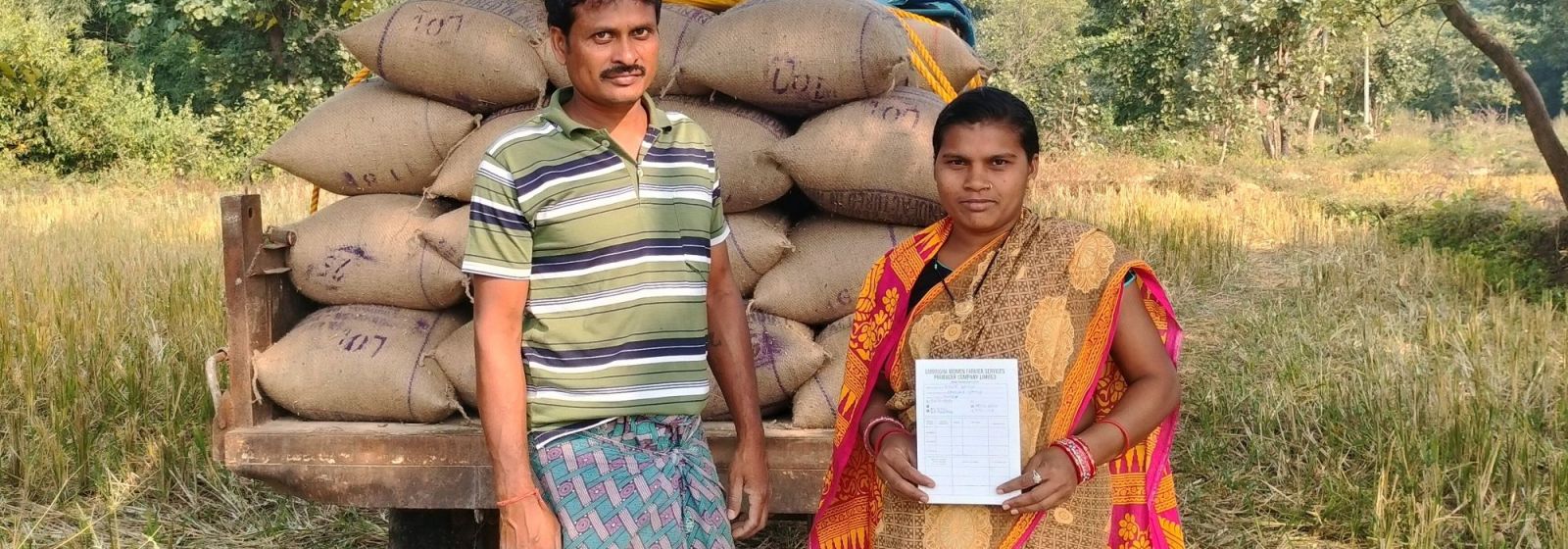
Two Farmer Producer Companies (FPC) in Odisha, India aim to further sustain their increased yields and bridge productivity gaps by facilitating and activating women's entrepreneurship in paddy seed production. This blog is a part of IRRI’s 2024 International Women’s Day campaign.
Read Part 1 of this special feature: Empowering women and improving rice yields and productivity through seed production
Seed production in agriculture is often associated with higher yield and economic returns. However, it is a story that transcends the fields and reveals significant changes in the lives of women farmers. In the heartland of Odisha, the narratives of women in agriculture are etched within the fields with each seed sown embodying their resilience and transformation. From the fertile soils of Kalahandi to the determined landscapes of Loisingha, the stories of women seed producers unfold and they paint a picture of empowerment and challenges. This shapes not only their lives but also the agricultural dynamics of their regions.
“Seed production has not just given us a source of income but has given us a voice in our households”, as expressed by Kalyani (name changed). Seed production means more than just earning money; it is a way to gain self-reliance and autonomy for the women engaged. "Seed production became a source of income for us, the ones who couldn't pursue formal education. It gave us hope and a chance to stand on our own," Kalyani reflects.
“Being a part of the FPC helps us reach bigger markets, giving us a stronger voice in the sales process as a collective and fetch better returns for our hard work.” While few farmers in these regions are engaged in seed production through collaboration with private seed companies, their involvement in FPC-led seed production signifies a desire for enhanced market access with better prices, quality assurance, access to resources, and strengthened institutional networks.
The FPC allowed these women to break into a domain traditionally dominated by men and largeholder farmers - enabling them to engage in a capital-intensive business line previously considered beyond their reach. However, it was not all easy. Both in Kalahandi and Loisingha, women faced multifold challenges, including being members of marginalized castes and tribes. While land ownership continues to be a challenge, possession of a Farmer ID has proven instrumental in mitigating these challenges as these provide official recognition. This enables women to access resources, government schemes, and support programs. They have overcome some challenges and pool resources for ventures previously considered beyond their reach.
Before their affiliation with the FPC, the women farmers procured seeds from various outlets, ranging from government agencies to local shops and some relied entirely on the seeds saved from the previous harvest. Champa, a woman farmer, encapsulates the collective sentiment stating, "The seeds we used previously didn't perform well. Joining the FPC changed everything. Now, we can access quality seeds with significantly improved yields." This encouraged them to shift to seed production where returns are higher. " Financial gains allowed us to explore poultry farming, invest in our children's education, and contribute more to our households," shared Rani, a woman from Loisingha, highlighting the multifaceted impact beyond income.
The journey of these seed producers is marked by tangible outcomes. "Being part of the FPC empowered me financially; I am now able to support my family and invest in my children's education," shared Priya, a member of the FPC. Echoing a sentiment prevalent among these women. Kavita, another active participant, remarked, "Through the FPC, I learned new farming techniques and gained valuable skills in seed production, enabling me to improve crop yield and quality."
Beyond individual growth, their engagement in FPCs has catalyzed community leadership, providing a platform for women to become influential voices in the community. Sunita, a dedicated member, expressed, "The FPC provided me with opportunities to become a leader in my community. I now have a voice and actively contribute to decision-making processes." These narratives of financial empowerment, skill enhancement, and leadership highlight the multifaceted impact of FPCs on women in seed production, underlining the transformative power of their involvement in these organizations.
What can be learned from the FPC promotion efforts in India?
Strategies for advancing women's inclusion in FPCs should go beyond a mere focus on women’s numerical participation and center on holistically engaging women through inclusive, sustainable, and empowering approaches.
-
Tailored and comprehensive skill development is key
An effective strategy involves prioritizing tailored education and skill development programs specifically crafted for women. By sharing practical knowledge on seed production techniques, crop management, and business skills, these initiatives can significantly bolster the capabilities of women farmers, enabling them to confidently engage in various aspects of agricultural ventures.
The Women Entrepreneurship Program (WEP), often likened to a mini MBA program implemented by ALF, has played a crucial role in empowering women in their agricultural business endeavors.
-
Nurturing women’s leadership
Promoting women's involvement in leadership capacities within FPCs, households, and communities is crucial to leveraging their contribution to agricultural decision-making. This necessitates a variety of multidimensional approaches that are informed by cultural and contextual specificities to engage women in leadership positions in various ways. Implementing structures such as advisory committees or task forces at the FPC and community levels offers avenues for women to contribute their expertise and insights. Other similar interventions can be designed to facilitate women’s assumption of leadership positions without the need to ascribe formal leadership titles to them. Moreover, crafting specialized roles aligned with individual skills—like marketing, quality control, community outreach, or knowledge-sharing—can effectively engage women in specific areas in which they conventionally do not participate. This fosters their active participation and impact and sows the seeds for social change.
-
Policies and schemes that can ease women’s access to resources
Ensuring access to resources like land, finance, and technology is critical. Land ownership restrictions have persistently hindered women's participation in seed production. Addressing this challenge through policies that grant women equitable access to land and credit can notably enhance their involvement in seed production initiatives and within FPCs.
The Loisingha and the Adarsh FPCs are a testament to the empowering potential of the seed systems for women producers and the learning from this experience has immense potential to inform future efforts for engaging women in enterprises such as paddy seed production, by drawing on the power of collective action and enabling partnerships.